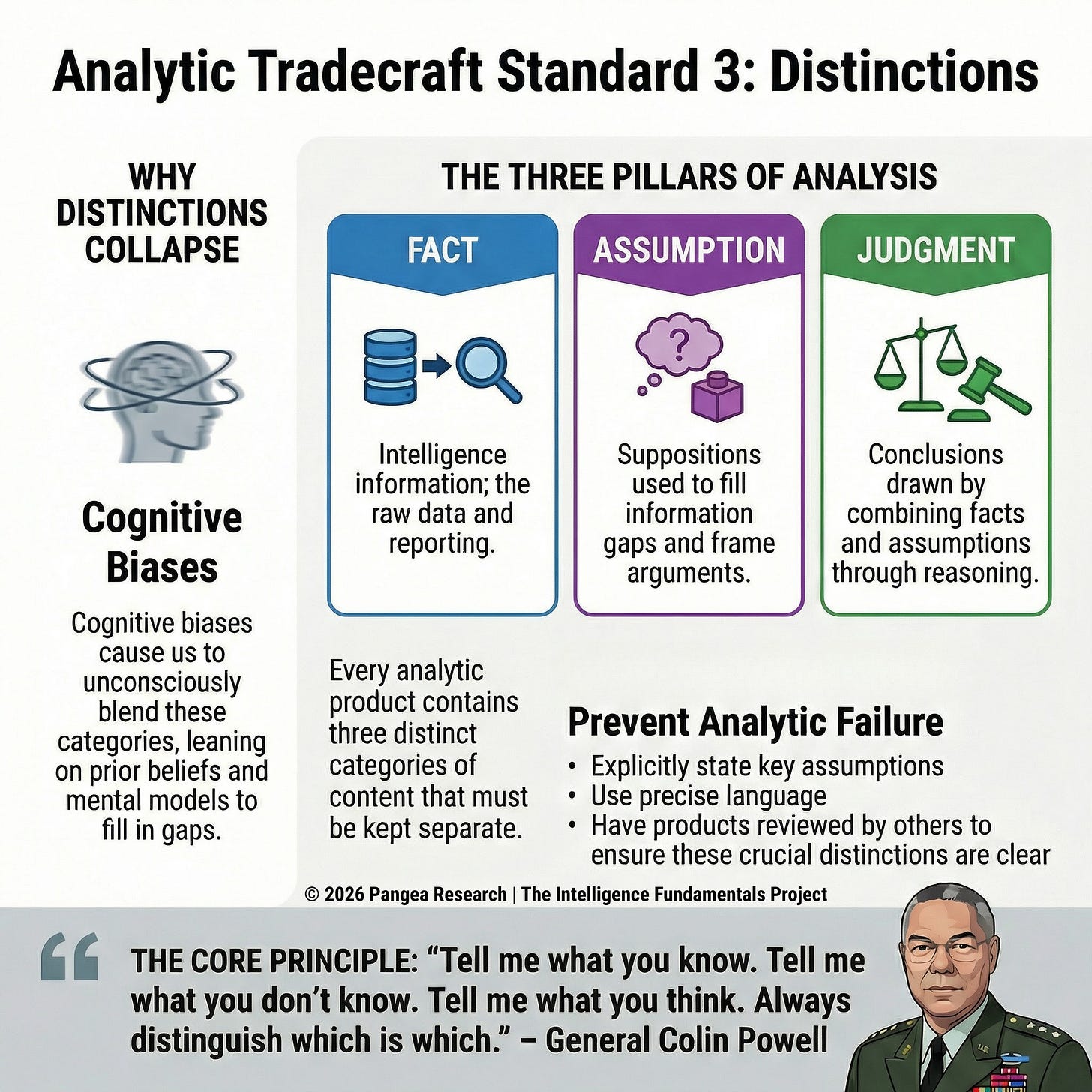
Every analytic product contains three categories of content:
Intelligence information is the factual base, the reporting and data that analysts collect and evaluate.
Assumptions are the suppositions used to frame or support an argument; they fill gaps where information doesn’t reach (ICD 203 2015).
Judgments are the conclusions analysts draw by combining information with assumptions through reasoning (ICD 203 2015).
ICD 203 requires that analytic products clearly distinguish statements that convey underlying intelligence information from statements that convey assumptions or judgments (ICD 203 2015). When these categories blur together, the consumer can’t tell what the analyst actually knows, what the analyst is taking for granted, and what the analyst has concluded. A police lieutenant reading a threat assessment, a general counsel reviewing a due diligence report, and a military commander reading an intelligence estimate all face the same problem when those lines aren’t clear: they’re making decisions on a foundation they haven’t been allowed to evaluate.
General Colin Powell distilled this into guidance that has become a standard reference point across military intelligence: “Tell me what you know. Tell me what you don’t know. Tell me what you think. Always distinguish which is which” (JP 2-0 2022). That’s easy to say and genuinely hard to do, because the human mind works against the effort at every stage.
Why Distinctions Fail
Cognitive science explains why analysts routinely blend information, assumptions, and judgments without realizing they’ve done it. Analysts perceive the world through mental models built from prior experience, training, and accumulated knowledge. These models channel and focus perception, and they can distort it (Heuer 1999). Beliefs, assumptions, concepts, and information retrieved from memory form a mind-set that guides how new information gets processed. When information is lacking, analysts lean heavily on prior beliefs and assumptions to fill the void (Heuer 1999). This reliance is largely unconscious. An analyst who has spent years working a particular region or threat will hold dozens of working assumptions about how actors in that space behave, what motivates them, and what they’re likely to do next. Many of those assumptions have never been written down, examined, or challenged.
Consider what happens when a corporate security analyst writes “the threat actor is consolidating access across our European subsidiaries.” That sentence could be a factual summary of confirmed intrusion activity, an inference drawn from a handful of anomalous log entries, or an assumption carried forward from a previous quarterly assessment. The analyst may not consciously know which one it is. Cognitive limitations cause people to employ simplifying strategies and rules of thumb that ease the burden of processing information, and these strategies are the source of cognitive biases that lead analysts to rely on preexisting mental models rather than objective realities on the ground (Kwoun & Schmor 2020).
Several specific biases make distinction failures more likely. Assimilation bias causes information consistent with an existing mind-set to reinforce existing beliefs while information that contradicts the model gets overlooked, distorted, or rationalized away (Heuer 1999). A fraud investigator who believes early in a case that the CFO is the primary actor will unconsciously read subsequent financial records as confirming that theory, even when the same records are equally consistent with a different suspect. Mirror-imaging leads analysts to project their own cultural framework onto foreign actors, substituting their own logic for the target’s actual decision-making calculus (Heuer 1999). A corporate intelligence analyst assessing a foreign competitor’s likely response to a price war may assume the competitor will prioritize shareholder value, when the competitor’s actual priorities are market share and government relationships. Availability bias gives unwarranted weight to vivid, concrete information while abstract or statistical evidence with greater analytical value gets discounted (Heuer 1999). Each of these biases operates by quietly converting assumptions into apparent facts. The investigator doesn’t think they’re assuming the CFO is guilty; they think the evidence points that way.
Poor Distinctions
When assumptions and judgments masquerade as established information, consumers make decisions on a foundation they haven’t been allowed to evaluate. A client who reads a background investigation report stating that “the subject has ties to organized crime” will act on that differently than one who reads “a single source with unconfirmed access claims the subject has ties to organized crime, though no corroborating records or reporting support this.” Both statements might reflect the same underlying information, but the difference is whether the analyst has been transparent about what they’re working with. Joint doctrine frames this in military terms: the commander’s determination of appropriate objectives and operations may rest on knowing whether intelligence is “fact” or “assumption,” and knowing the particular logic used to develop an intelligence estimate (JP 2-0 2022). The principle applies identically when the consumer is a district attorney deciding whether to pursue an indictment, a board of directors evaluating an acquisition, or a security director allocating protective resources.
A corporate executive reviewing a competitive intelligence assessment that blends sourced information with analyst inference will read the whole product through the lens of what they already expect (Heuer 1999). If the assessment confirms their business strategy, they’ll treat the analyst’s inferences as validated findings. If it contradicts them, they’ll dismiss the entire product as speculative. Either way, they haven’t been given the tools to evaluate the analysis on its merits, because the analyst hasn’t separated what is known from what is inferred. The same dynamic operates in law enforcement: a detective who already has a theory of the case will read an intelligence product that mixes established facts with analyst inferences as confirming their theory, because ambiguous conclusions skew toward whatever the reader already believes.
Separating Facts from Judgment
The CIA’s tradecraft guidance draws a line that many analysts find harder to maintain than it appears. Verified information, something known to exist or to have happened, counts as fact. Information is the content of reports, research, and analytic reflection that helps evaluate the likelihood that something is factual and reduces uncertainty (CIA 1995). The gap between those two categories is where most distinction failures occur. Analysts may have direct information on what a foreign leader said, and can responsibly conclude this as factual. But what that leader believes, intends to do, and will do cannot be known to be true on the basis of a report on what they said (CIA 1995). A corporate intelligence analyst faces the same boundary: a competitor’s public earnings call is factual record, but what it reveals about strategic intent is inference.
Drawing conclusions from facts is inference, and inference requires transparent labeling (Global Justice Information Sharing Initiative 2003). Law enforcement intelligence defines this boundary in the same terms. Intelligence is information that has been analyzed to determine its meaning and relevance (Global Justice Information Sharing Initiative 2003). The analytical step that transforms raw information into intelligence is where assumptions and judgments enter the picture, and that step needs to be visible to whoever reads the product. A threat assessment that presents inferred intent as established fact puts officers at risk. A due diligence report that treats market speculation as confirmed intelligence exposes the client to liability.
When analysts lack a solid informational base and rely on a small number of reports, they should attribute conclusions to the source rather than presenting them as their own (CIA 1995). Clandestine agents, foreign officials, and local media jump to conclusions. A private investigator’s single confidential source may be doing the same. Analysts working in any discipline should not replicate that pattern by absorbing a source’s speculation and repackaging it as analytical finding.
The Language Problem
Even analysts who understand the distinction conceptually can undermine it through imprecise language. The DIA style manual addresses several patterns that blur the line between information and judgment. Words that already express a degree of judgment, such as “imply,” “indicate,” and “suggest,” should not be combined with qualifiers like “may,” “likely,” and “probably” (DIA 2015). Stacking these qualifiers creates a sentence where the reader can’t determine whether the analyst is confident or hedging. “The lull in attacks may indicate the rebels are ready to negotiate” contains two layers of uncertainty that obscure rather than clarify. Either “the lull in attacks indicates the rebels are ready to negotiate” or “the lull in attacks may mean the rebels are ready to negotiate” gives the reader a clearer signal (DIA 2015).
“Possible” and “could” are among the worst offenders. The DIA advises against using either to describe an event unless the alternative is genuinely impossible, because these words are not analytic judgments; they are statements that the event is not impossible (DIA 2015). Heuer reinforces this: to say that something could happen or is possible is not useful to the decision-maker; the analyst should narrow the range of uncertainty by stating the probability of the event (Heuer 1999). An analyst who writes “it is possible that the suspect has fled the jurisdiction” has conveyed almost nothing. An analyst who writes “limited reporting suggests the suspect left the jurisdiction within 48 hours of the warrant” has distinguished the information base from the inference and given the consumer something to work with.
Burying verbs inside nouns weakens the signal and makes it harder for readers to identify what’s a factual claim and what’s a judgment. “Chemical attacks are in violation of the treaty” obscures the assertion. “Chemical attacks violate the treaty” states it directly (DIA 2015). The more directly a sentence states its content, the easier it is for a reader to evaluate whether that content rests on sourced fact, analytical inference, or assumption.
Testing Assumptions
ICD 203 specifies that products should state assumptions explicitly when an assumption is the central load-bearing element of an argument, the piece that, if removed, collapses the entire conclusion. Products should also state assumptions when they bridge key information gaps, and explain what happens to the judgment if an assumption proves incorrect (ICD 203 2015). The hard part is that the most consequential assumptions are the ones analysts don’t realize they’re making.
Identifying hidden assumptions is one of the most difficult challenges an analyst faces, because assumptions are ideas held, often unconsciously, to be true and therefore are seldom examined and almost never challenged (CIA 2009). The key assumptions check is a structured technique designed to address this problem. It requires the analyst to list and review the working assumptions on which fundamental judgments rest, then evaluate whether each assumption remains valid. The technique exposes faulty logic, uncovers hidden relationships between key factors, and identifies developments that would cause the analyst to abandon an assumption.
A due diligence team investigating a potential acquisition target may assume the target company’s financial reporting follows the same accounting conventions as the acquirer’s industry. If that assumption is wrong and no one identifies it, the team’s valuation analysis will be built on a foundation the client hasn’t been allowed to examine. A law enforcement analyst building a threat assessment around a gang’s territorial patterns may be working from a model of gang behavior that fits a different city, a different era, or a different organizational structure entirely. Listing those assumptions and asking “what changes if this is wrong” is a straightforward exercise that catches errors before they reach the consumer.
Analysis of competing hypotheses (ACH) provides another mechanism for maintaining distinctions. Heuer’s framework explicitly requires analysts to include their own assumptions and logical deductions alongside concrete evidence in the list of factors being evaluated, because such assumptions often drive the final judgment and need to be included in the analysis rather than hidden behind it (Heuer 1999). When analysts conduct ACH honestly, they’re forced to separate what they know from what they’re assuming, because the framework treats both as distinct inputs that can be evaluated and challenged independently.
Assumptions can sometimes be adequately articulated within the text of an assessment. More complex products, where the causal chain from evidence through assumption to conclusion is harder to follow, may benefit from a textbox or sidebar that lays those relationships out explicitly (CIA 1995). The format varies; the discipline doesn’t. Assumptions need to be visible, and the logical path from information through assumption to judgment needs to be traceable.
Review Processes
Review processes catch distinction failures that self-editing misses. Heuer recommends that reviewers explicitly question the mental model the analyst employed, asking what assumptions the analyst has made that aren’t discussed in the draft but that underlie the principal judgments (Heuer 1999). Reviewers from outside the subject area are better positioned for this work than subject matter experts, because they aren’t absorbed in the substance and can focus on argumentation, internal consistency, logic, and the relationship of evidence to conclusion (Heuer 1999). A terrorism analyst reviewing a cyber assessment will spot unstated assumptions about attacker motivation that the cyber team treats as given. A corporate intelligence shop can replicate this by having an analyst from one portfolio review products from another before they go out the door.
Within the IC, each agency and intelligence organization must maintain a program of product evaluation using the analytic standards as its core assessment criteria (ICD 203 2015). The ODNI Analytic Ombuds fields concerns about how standards are applied in analytic products across the community (ICD 203 2015). Most organizations reading this article won’t have an ombudsman or a formal evaluation program, but the underlying principle scales to any size: someone other than the author should check whether the product separates information from assumption from judgment before it reaches a consumer.
One self-review technique from the CIA’s tradecraft guidance works at the individual analyst level. The analyst lists the five or so matters they would personally want clarified if they were the decision-maker the product supports, then checks which paragraphs of the draft provide actionable information or insight for each one (CIA 1995). Gaps in that mapping reveal where the product is making claims without showing the reader what category those claims fall into, whether it’s established information, working assumption, or analytical conclusion.
Assessments also degrade over time if the underlying information base isn’t periodically reexamined. Analysts should perform regular checks of the information supporting their analytic judgments; without that discipline, important conclusions become anchored to weak information (CIA 2009). What started as a cautious inference, hedged with appropriate caveats, hardens into an accepted position as it gets repeated across products and briefings. The original source limitations fall away through familiarity, and a tentative judgment circulates as established fact. Periodic review of the information base is how organizations prevent that drift.
Closing
Every product you write asks the consumer to trust your work enough to act on it. That trust is only as good as the consumer’s ability to see what you’re working with. When information, assumptions, and judgments run together, the consumer is left to guess which parts of your assessment rest on solid ground and which parts rest on your best read of an incomplete picture. Most consumers won’t guess well, and most will guess in whichever direction confirms what they already think.
The discipline is straightforward: say what you know and where it came from, say what you’re taking for granted and why, and say what you’ve concluded from putting the two together. When a judgment rests on an assumption that could break, say so. When an inference rests on a single source, say that too. The tools for doing this well, from structured assumption checks to outside review to the CIA’s self-review technique, all serve the same function: they force you to see the categories in your own work before the consumer has to guess at them.
The analyst who gets this right doesn’t produce hedged, tentative products full of disclaimers. They produce clear products where the consumer can see exactly which load-bearing elements are solid, which ones are provisional, and what would need to change for the conclusion to fall apart. That’s what Powell was asking for, and it’s what every consumer deserves, whether they’re a military commander, a general counsel, or a client reading a background report.
References
Central Intelligence Agency, Directorate of Intelligence. 1995. A Compendium of Analytic Tradecraft Notes. Washington, DC: Central Intelligence Agency.
Defense Intelligence Agency. 2015. Defense Intelligence Agency Style Manual for Intelligence Production. Washington, DC: Defense Intelligence Agency.
Global Justice Information Sharing Initiative. 2003. National Criminal Intelligence Sharing Plan. Washington, DC: US Department of Justice.
Heuer, Richards J., Jr. 1999. Psychology of Intelligence Analysis. Washington, DC: Center for the Study of Intelligence, Central Intelligence Agency.
Joint Chiefs of Staff. 2013. Joint Intelligence (JP 2-0). Washington, DC: Joint Chiefs of Staff.
Maj. James S. Kwoun, U.S. Army, and Lt. Col. Robert W. Schmor, U.S. Army. 2021. Analytic Tradecraft Standards: An Opportunity to Provide Decision Advantage for Army Commanders. Accessed December 3, 2025. https://www.armyupress.army.mil/Portals/7/military-review/Archives/English/MA-21/Kwoun-Tradecraft-Standards.pdf.
Office of the Director of National Intelligence. 2015. Intelligence Community Directive 203: Analytic Standards. Washington, DC: Office of the Director of National Intelligence.
Central Intelligence Agency. 2009. A Tradecraft Primer: Structured Analytic Techniques for Improving Intelligence Analysis. Washington, DC: Central Intelligence Agency.
This piece was first published on our Substack.
Read the original on Substack