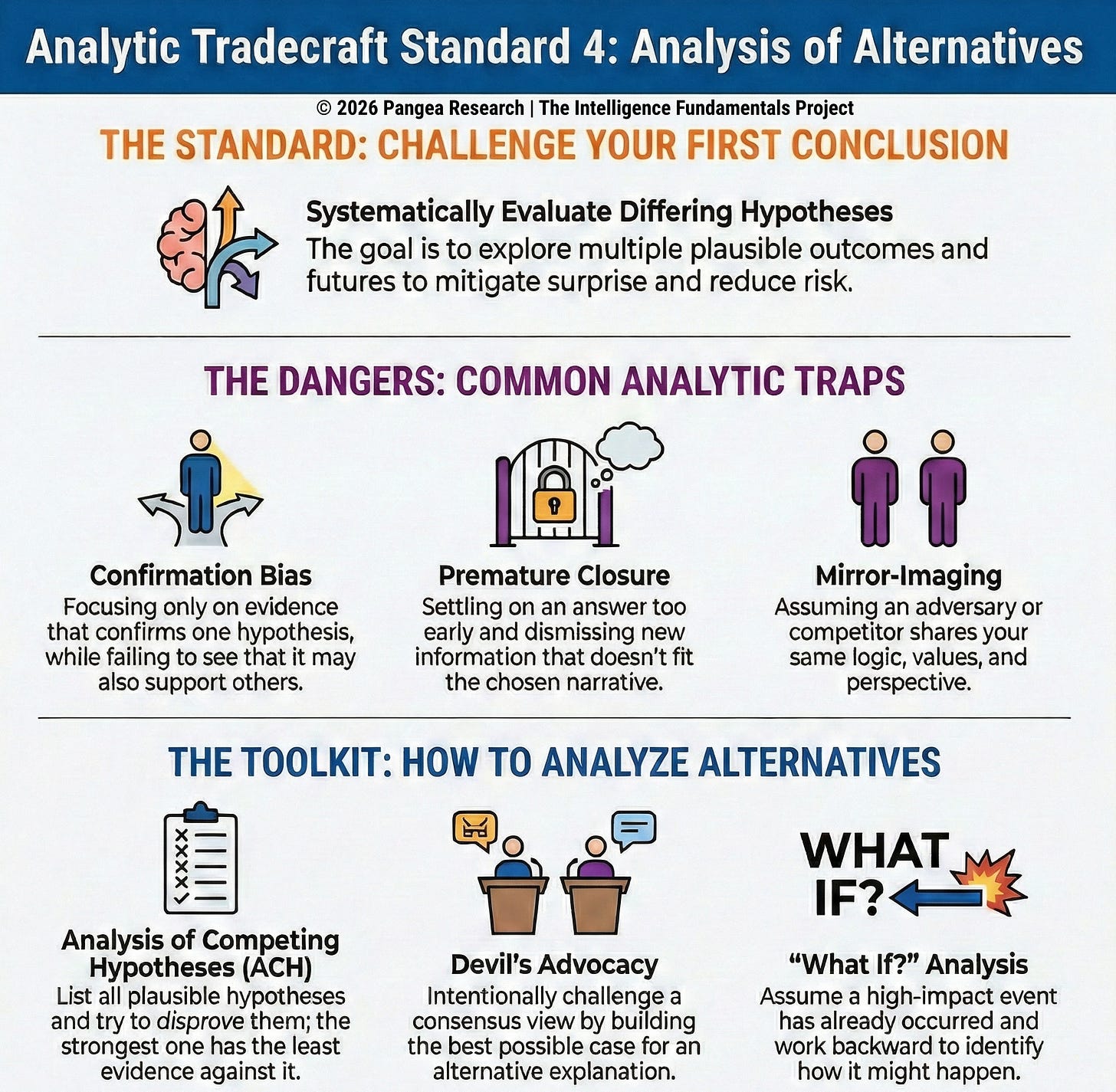
Analysts gravitate toward the explanation that fits the evidence they’ve already gathered. That tendency is natural and efficient, which is exactly what makes it dangerous. ICD 203 defines analysis of alternatives as “the systematic evaluation of differing hypotheses to explain events or phenomena, explore near-term outcomes, and imagine possible futures to mitigate surprise and risk” (ICD 203 2015). The directive requires analytic products to “identify and assess plausible alternative hypotheses,” particularly “when major judgments must contend with significant uncertainties, or complexity (e.g., forecasting future trends), or when low probability events could produce high-impact results” (ICD 203 2015). That language covers a staggering range of intelligence work, because most assessments worth writing involve uncertainty, complexity, or consequences.
Joint doctrine frames the same requirement in operational terms. Accurate intelligence estimates should “inform the JFC [Joint Force Commander] of the full range of actions open to the adversary and estimate the relative order of probability of their adoption” (JP 2-0 2013). When a military commander receives an estimate of what the enemy will do, that estimate needs to account for everything the enemy could plausibly do, ranked by likelihood and flagged by danger. A corporate executive reviewing a competitive intelligence assessment has the same need: what are the plausible moves, how likely is each, and which ones would hurt most? Decision-makers who receive a single-outcome prediction with no alternatives are poorly served, whether they’re planning a military operation, a merger, or a criminal investigation.
Why Single-Outcome Analysis Fails
Richards Heuer identified the core problem decades ago: analysts tend to pick the first explanation that seems satisfactory and stop looking (Heuer 1999). Decision analysts call this satisficing, and it means choosing the first solution that clears a basic threshold of plausibility rather than working through all the possibilities to find the best one. Several explanations might seem satisfactory, but only one of them is closest to the truth, and the analyst who stops at the first reasonable answer never finds out whether a better one existed. Heuer argued that management should reject most single-outcome analysis on key issues, meaning the single-minded focus on what the analyst believes is probably happening or most likely will happen (Heuer 1999). A corporate due diligence team investigating a potential acquisition target might assume that the target’s rapid revenue growth reflects genuine market demand because that’s the narrative the target’s management has presented and because the financial statements show consistent top-line increases. If the team never seriously considers whether the revenue is sustainable, whether key contracts are at risk of non-renewal, or whether the growth depends on a single customer relationship that could evaporate, every downstream conclusion rests on an untested foundation. The alternative explanations don’t require exotic thinking; they require someone to ask “what if the growth story isn’t what it appears?” and then look for evidence that would answer that question.
The problem compounds because confirming evidence is everywhere. When analysts focus mainly on trying to confirm one hypothesis they think is probably true, they are easily led astray by the sheer volume of evidence that appears to support their view (Heuer 1999). They fail to recognize that most of this evidence is also consistent with other explanations. A law enforcement analyst tracking a suspected drug trafficking network might gather extensive evidence of financial transactions, known associates, and travel patterns that all fit the trafficking hypothesis. That same evidence, every piece of it, might equally support a money laundering operation, a fraud scheme, or legitimate business activity. Until the analyst deliberately evaluates the evidence against each possibility, the apparent strength of the case for trafficking is an illusion built on confirmation.
Two additional cognitive shortcuts make single-outcome analysis worse. Incrementalism narrows the range of alternatives to those representing marginal change from an existing position, without considering the possibility that something fundamentally different is happening (Heuer 1999). An intelligence shop that has assessed a foreign government as stable for three consecutive quarterly reports will tend to generate alternatives that are minor variations on “still stable” rather than seriously considering regime collapse or sudden alignment shifts. Consensus drives analysts toward the alternative that will generate the least friction, including the version of simply telling the boss what they want to hear (Heuer 1999). A corporate intelligence team reporting to a CEO who is publicly committed to a market expansion isn’t eager to present the alternative in which that expansion triggers a competitor response that wipes out the projected gains. Both shortcuts feel rational in the moment and produce analysis that misses the possibilities that matter most.
Premature Closure & Unchallenged Assumptions
Premature closure happens when an analyst settles on a hypothesis early, stops seeking disconfirming evidence, and dismisses information that doesn’t fit. The Tradecraft Primer describes this as the failure to identify the relevant and diagnostic information, because the analyst has already decided what’s relevant based on the hypothesis they picked first (CIA 2009). A systematic approach that considers a range of alternative explanations and outcomes is one way to ensure analysts don’t dismiss potentially relevant hypotheses and the supporting information that goes with them, resulting in missed opportunities to warn (CIA 2009). If you haven’t defined the alternatives, you don’t know what evidence would support or undermine them, so you can’t recognize that evidence when it crosses your desk.
Heuer found that when analysis turns out to be wrong, it is frequently because of key assumptions that went unchallenged and proved invalid (Heuer 1999). The assumption doesn’t have to be exotic to be devastating. It just has to be convenient, plausible, and aligned with what everyone involved wants to believe. When the due diligence team discussed earlier accepts the target company’s growth narrative at face value, that assumption shapes the entire investigation: the team focuses on validating the growth story rather than probing whether the revenue picture is as solid as it looks. If the assumption is wrong, every downstream conclusion built on it collapses, and the acquiring company discovers the problem after closing. Testing the assumption required someone to ask “what if?” and then look for evidence that would answer the question. Nobody did, because the answer everyone expected was also the answer everyone wanted.
When analysts project their own logic, values, or institutional norms onto the subject of their analysis, a tendency called mirror-imaging, they eliminate alternatives that don’t make sense from their own perspective, even when those alternatives are exactly what the adversary or subject intends (Heuer 1999). The US perspective on what is in another country’s national interest is usually irrelevant to intelligence analysis; judgment must be based on how the other country perceives its national interest (Heuer 1999). A corporate security team assessing a foreign competitor’s likely response to a patent dispute might assume the competitor will pursue legal remedies because that’s what their own company would do, when the competitor’s actual playbook involves regulatory pressure, media campaigns, or direct approaches to key employees. Mirror-imaging produces a false sense of confidence because the analyst has reasoned through the problem carefully, just from the wrong starting point.
More SATs!
We’re going to talk about SATs in each one of these articles because they are relevant in each of these areas (spoiler alert!) Analysis of Competing Hypotheses, or ACH, requires analysts to explicitly identify all the reasonable alternative hypotheses, then array the evidence against each hypothesis rather than evaluating the plausibility of each hypothesis one at a time (CIA 2009). The method proceeds by trying to disprove hypotheses rather than prove them, and the most probable hypothesis is usually the one with the least evidence against it, rather than the one with the most evidence for it (Heuer 1999). The natural human approach is to look for evidence that confirms what we already believe. ACH forces the analyst to look for evidence that eliminates possibilities, which produces a fundamentally different evaluation. For a law enforcement fusion center analyst assessing whether a series of suspicious financial transactions represents terrorist financing, organized crime, or legitimate business, ACH requires listing all three hypotheses, arraying every piece of evidence against each one, and identifying which hypothesis the evidence most consistently fails to eliminate. The Tradecraft Primer notes that ACH ensures all information and argumentation is evaluated and given equal treatment when considering each hypothesis, and prevents the analyst from premature closure on a particular explanation (CIA 2009).
Devil’s advocacy involves challenging a single, strongly held view or consensus by building the best possible case for an alternative explanation, which provides further confidence that the current analytic line will hold up to close scrutiny (CIA 2009). Team A/Team B uses separate analytic teams that draft the best possible case for competing positions: Team A argues for the dominant or consensus view, Team B argues for the alternative or minority view (CIA 2009). A private investigation firm assessing the intentions of a litigation target could assign one analyst to build the strongest case that the target will settle and another to build the strongest case that the target will fight aggressively, then compare which case better accounts for the available evidence. Red team analysis models the behavior of an adversary by trying to replicate how they would think about an issue; analysts can never truly escape their own experiences and perspectives, but red teaming prevents them from falling into mirror-imaging unconsciously (CIA 2009).
Alternative futures analysis systematically explores multiple ways a situation can develop when there is high complexity and uncertainty, providing an effective means of weighing multiple unknown or unknowable factors and presenting a set of plausible outcomes (CIA 2009). “What If?” analysis assumes that an event with potential impact has already occurred and works backward to explain how it might come about, which helps analysts address the factors that could cause or alter the event and likely signposts that the event is imminent (CIA 2009). High-impact/low-probability analysis highlights a seemingly unlikely event that would have major consequences if it happened, and mapping out the course of such an event can uncover hidden relationships between key factors and assumptions (CIA 2009). A corporate intelligence team preparing a strategic assessment for a board considering expansion into an unstable market could use alternative futures to model scenarios ranging from political stabilization to civil unrest to regulatory nationalization, identifying the indicators that would signal which future is emerging and giving the board specific things to watch for with pre-planned responses for each scenario.
Military intelligence adds wargaming to this toolkit, where the intelligence staff operates as the opposing commander to project enemy reactions to friendly actions and estimate how the adversary’s decision-making will shift at critical points (FM 2-0 2023). Any organization that models how a competitor, adversary, or subject of investigation is likely to react to the organization’s own actions is doing a version of this work, whether the context is a military campaign, a litigation strategy, or a competitive market move.
The Paradox of Warning
Joint doctrine describes the paradox of warning: the adversary alters their course of action once the friendly reaction to the initial warning makes the original course of action no longer viable, so the act based on the successful intelligence prediction causes the prediction to be incorrect (JP 2-0 2013). An analyst correctly identifies that a competitor is about to launch a predatory pricing campaign. The company acts on that warning by preemptively adjusting its own pricing and securing key customer contracts. The competitor, seeing that the window has closed, abandons the campaign. The analyst’s prediction now appears wrong, the competitor didn’t launch the campaign, even though the warning was accurate and the response was effective. This paradox pressures analysts to avoid making warnings that might not “come true,” which undermines the entire purpose of predictive analysis. Organizations that understand this dynamic protect their analysts from being penalized for successful warnings that altered the outcome they predicted.
What Good Alternative Analysis Looks Like in the Finished Product
ICD 203 specifies what alternative analysis should contain: products should address factors such as associated assumptions, likelihood, or implications related to US interests, and should identify indicators that, if detected, would affect the likelihood of identified alternatives (ICD 203 2015). A finished intelligence product should tell the consumer what alternatives were considered, what assumptions underlie each one, how likely each is relative to the others, what the consequences are if each alternative turns out to be correct, and what specific observables would signal that the balance is shifting. DIA guidance recognizes that not every alternative generated during the analytical process necessarily warrants presentation to the client, allowing flexibility in how the standard is applied in finished products (Schmor & Kwoun 2021). Analysts think through all plausible alternatives but present the ones the consumer needs to understand in order to make good decisions.
Heuer argued that any written argument for a judgment is incomplete unless it also discusses the alternative judgments that were considered and the reasons they were rejected (Heuer 1999). For the consumer, this provides transparency into the analyst’s reasoning and the opportunity to push back if they believe a dismissed alternative deserves more weight. For the analyst, the discipline of writing out why an alternative was rejected forces a harder examination than simply letting it fade from consideration. Review procedures should explicitly question the mental model employed by the analyst in searching for and examining evidence, asking what alternative hypotheses were considered and rejected, for what reason, and what could cause the analyst to change their mind (Heuer 1999).
The CIA’s Directorate of Intelligence, the analytical arm of the agency responsible for producing finished intelligence, took this further by connecting alternative analysis to contingency planning. On issues vital to US security, analysts must help policymakers and warfighters engage in contingency planning by relating their analysis to a range of plausible outcomes, including alternatives the analysts consider remote possibilities against which policy planners may nonetheless decide to deploy resources (CIA 1995). A general counsel reviewing a threat assessment before a major transaction needs to know what alternatives the analyst considered, even the unlikely ones, because the general counsel’s risk tolerance and the analyst’s probability assessment aren’t the same thing. An alternative the analyst considers a 10% likelihood might be exactly the scenario the client wants to plan for because the consequences of being caught unprepared are catastrophic. Withholding alternatives because the analyst judges them improbable denies the consumer information they need to make their own risk calculations.
Closing
Every structured technique in this article exists to counteract the same basic tendency: the pull toward the first explanation that fits. ACH forces you to test evidence against possibilities you’d rather not consider. Devil’s advocacy and Team A/Team B force you to build cases you don’t believe in and discover they’re stronger than you expected. Alternative futures and “what if” analysis force you to map scenarios your consumer might need to plan for even if you think they’re unlikely. None of these techniques guarantee the right answer. What they guarantee is that you’ve looked in more than one direction before telling someone where to go.
An analyst who builds an airtight case for the most likely outcome but never examines what else could happen has given the consumer confidence without coverage. The consumer plans for one future, and when a different one arrives, they’re exposed in exactly the way the assessment was supposed to prevent. Showing readers the full range of what could happen, how likely each outcome is relative to the others, and what early signals would tell them the picture is shifting lets them make their own risk calculations with the complete picture. An analyst who withholds a low-probability alternative because they judged it unlikely has substituted their own risk tolerance for the consumer’s. The general counsel, the police commander, and the corporate security director all get to make that call for themselves, but only if you’ve given them the full picture to work with.
References
Central Intelligence Agency. 1995. A Compendium of Analytic Tradecraft Notes. Directorate of Intelligence.
Central Intelligence Agency. 2009. A Tradecraft Primer: Structured Analytic Techniques for Improving Intelligence Analysis.
FM 2-0. 2023. Intelligence. Department of the Army.
Heuer, Richards J. 1999. Psychology of Intelligence Analysis. Central Intelligence Agency.
ICD 203. 2015. Analytic Standards. Office of the Director of National Intelligence.
JP 2-0. 2013. Joint Intelligence. Joint Chiefs of Staff.
Schmor, Robert W. and James S. Kwoun. 2021. “Analytic Tradecraft Standards: An Opportunity to Provide Decision Advantage for Army Commanders.” Military Review, March-April 2021.
This piece was first published on our Substack.
Read the original on Substack