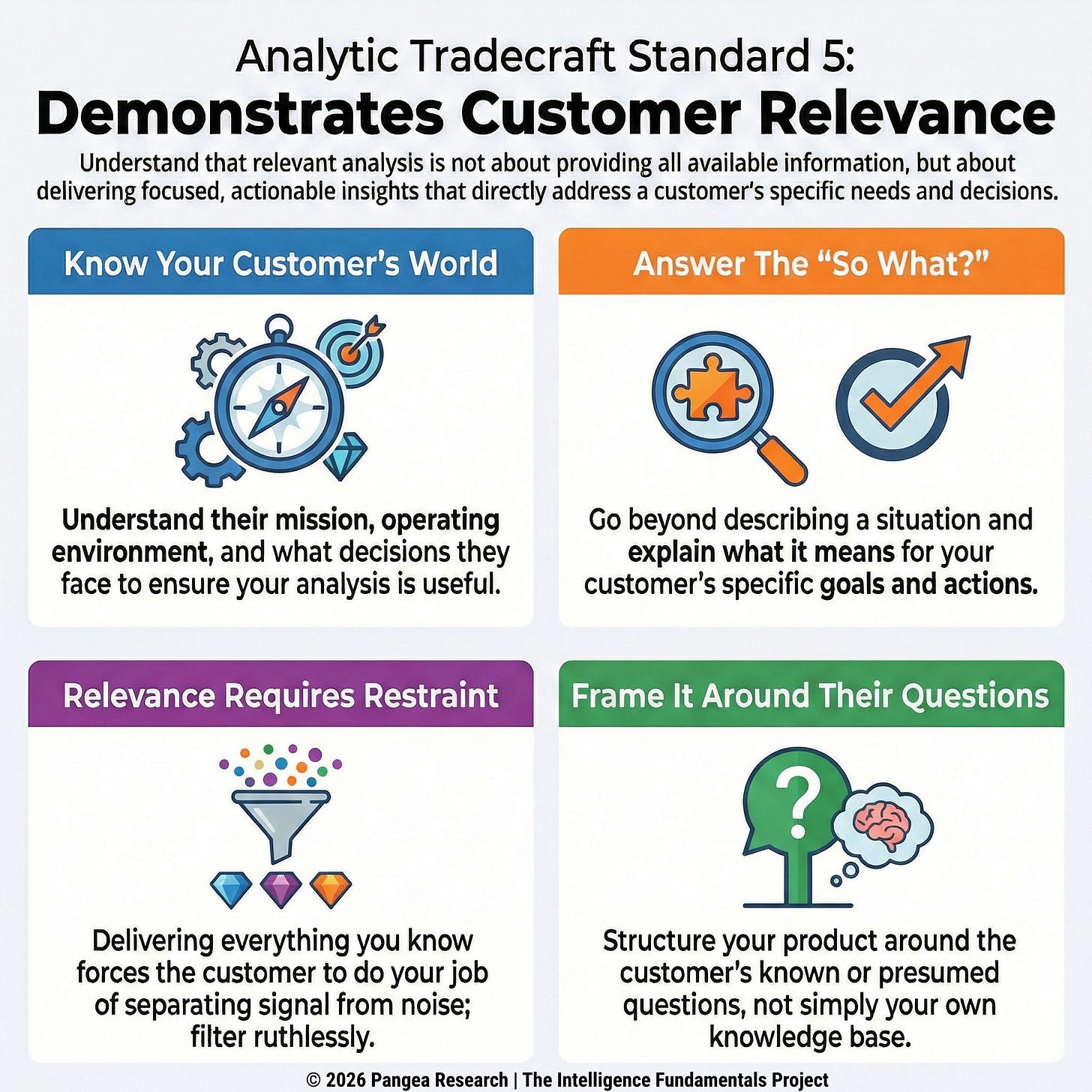
You can produce technically flawless work and still deliver something nobody needs :( No one wants to waste their time or energy like that. ICD 203 requires that analytic products “provide information and insight on issues relevant to the customers of U.S. intelligence and address the implications of the information and analysis they provide” (ICD 203 2015). Products should “add value by addressing prospects, context, threats, or factors affecting opportunities for action” (ICD 203 2015). Those two sentences contain the entire standard, and they’re easy to read past without appreciating how much they demand. The first part requires you to know what their customers care about. The second part requires you to go beyond describing a situation and tell the customer what it means for them.
ICD 208 extends this by requiring intelligence organizations to ensure that their officers “know who their customers are by understanding their operating environment, including what information the customer needs, timeliness, classification limits, and how products can be most effectively and efficiently discovered and disseminated” (ICD 208 2017). Knowing your customer isn’t a soft skill bolted onto the analytical process; ICD 208 makes it an institutional obligation. An analyst who produces outstanding analysis on a topic their customer doesn’t need, in a format their customer can’t use, at a classification their customer can’t access, has satisfied none of these requirements regardless of how rigorous the underlying tradecraft is.
Intelligence must be relevant to the planning and execution of the operation at hand and aid the commander in accomplishing the mission, but it must not burden the commander with intelligence that is of minimal or no importance to the current mission (JP 2-0 2022). Relevance requires restraint. Delivering everything you know on a topic because some of it might be useful forces the consumer to do the analyst’s job of separating signal from noise, and most consumers don’t have time for that. One official told CIA interviewers that he didn’t have time for “whole sentences,” just for what it was the analyst wanted him to know (CIA 1995).
Knowing Your Customer’s World
To produce relevant intelligence, the J-2 staff must remain cognizant of the commander’s intent and understanding of how the operational concept inflicts desired effects upon the adversary to achieve the military objectives and secure the end state (JP 2-0 2022
). That’s doctrinal language for a straightforward idea: you have to understand what your customer is trying to accomplish before you can figure out what intelligence would help them accomplish it. Army doctrine reinforces this by requiring intelligence staff to present “clear, concise intelligence that meets the commander’s preferences, facilitates situational understanding, and is usable for decision making or other actions” (Department of the Army 2023). The emphasis on preferences is deliberate. Different consumers process information differently, prioritize different factors, and face different constraints on how they can use what you give them.
A private investigator working a litigation support case needs to understand what the attorney is trying to prove, what evidentiary standards apply, and what the opposing counsel is likely to argue. Without that understanding, the investigator might spend weeks developing a comprehensive background on a subject when what the attorney actually needs is documentation of specific activities during a narrow time window. A corporate intelligence analyst supporting a market entry decision needs to know what the executive team has already decided, what options remain open, and what factors would change their calculus. An assessment of the competitive landscape that doesn’t address the specific entry strategy under consideration is background reading.
To identify lines of analysis that provide value, analysts should think through what they would want to know if they were the decision-makers charged with leveraging an issue (CIA 1995). An analyst who is deeply knowledgeable about a subject but doesn’t understand the decisions the customer faces will produce analysis the customer can learn from but can’t act on. One way to bridge that gap is to organize an analytic effort around the known or presumed questions of key officials, and whenever appropriate, use those questions as section headings (CIA 1995). Structuring a product around the customer’s questions rather than the analyst’s knowledge base forces relevance into the architecture of the product itself.
Military intelligence formalizes this through Priority Intelligence Requirements, or PIRs, which outline the intelligence the commander deems necessary to accomplish the mission (SACLANT 2002). Analysts test relevance against specific questions: how is this event relevant to my commander? What impact does this event have on assigned forces or potential operations? Will this event shift the operating environment within the area of operations? (SACLANT 2002). A due diligence analyst could ask the same kind of questions: how does this finding affect my client’s decision to proceed with the acquisition? Does this information change the risk profile of the deal? Will this factor affect the valuation or the terms? If the answer to all three is no, the finding may be interesting but it isn’t relevant to the engagement, and including it in the report dilutes the findings that are.
The “So What?” Problem
DIA tells its analysts to “go beyond the obvious” and identify “vulnerabilities and leverage points” (Kwoun & Schmor 2020). That instruction targets the most common relevance failure: analysis that describes a situation thoroughly without telling the consumer what it means for their specific decisions. A law enforcement intelligence bulletin that reports a spike in vehicle thefts in a particular district has described something. A bulletin that connects that spike to a specific organized group operating out of an identified chop shop, notes that the group’s activity pattern suggests they’ll move to an adjacent district within weeks, and identifies the surveillance indicators that would confirm the shift has given the commander something to act on.
The CIA’s so-what test asks analysts to evaluate each section of a draft from the intended customer’s point of view: does the draft address specifically and effectively what key policymakers need to know to get their jobs done? (CIA 1995). That’s easy to state and genuinely hard to do well. Running it honestly requires the analyst to know what the customer’s job actually entails, what decisions are in front of them, and what information would change how they approach those decisions. An analyst who can’t answer those questions about their customer can’t meaningfully evaluate whether their product passes the so-what test.
The CIA’s action-support test works as a complement: analysts list the five or so matters they personally would want clarified if they were directly responsible for managing the policy action their product supports, then check each one against the paragraphs of the draft that provide actionable information or insight, and adjust the draft if key concerns aren’t addressed or if too many paragraphs aren’t directly related to specific concerns (CIA 1995). A corporate intelligence analyst could adapt this by listing the five decisions the executive team is facing on the issue and checking whether the draft addresses each one. A private investigator could list the five things the attorney needs to establish and verify that the report provides evidence or analysis bearing on each. If large sections of the draft don’t connect to any item on that list, those sections are candidates for cutting or condensing.
When Analysts Lose Relevance
Experienced analysts have an imperfect understanding of what information they actually use in making judgments; they are unaware of the extent to which their judgments are determined by a few dominant factors rather than by the systematic integration of all available information (Heuer 1999). Analysts actually use much less of the available information than they think they do (Heuer 1999). Additional detail on variables already in the analyst’s mental model and information on other variables that don’t significantly influence the judgment have a negligible impact on accuracy but form the bulk of the raw material analysts work with (Heuer 1999). Analysts tend to include information because they encountered it during the research process, not because the customer needs it. The result is products that are comprehensive in coverage but diluted in value.
Analysts also tend to uncritically relate new information to whatever has dominated their recent thinking, a tendency the OSINT Handbook calls evoked-set reasoning (SACLANT 2002). An analyst who spent the last six months working counternarcotics will tend to interpret ambiguous financial activity through a drug trafficking lens even when the current assignment is a fraud investigation. The information they include and the implications they draw will reflect their recent experience rather than the customer’s current need. An analyst working corporate competitive intelligence who just finished a project on regulatory risk may overweight regulatory factors in an assessment where the customer’s primary concern is market positioning.
Customers contribute to the problem too. The OSINT Handbook identifies two common attitudes that undermine relevance from the customer side: “tell me everything about everything” and “if I have to tell you what I need to know you are not doing your job” (SACLANT 2002). Both represent unworkable direction. The first produces information overload because the analyst has no basis for filtering. The second demands that analysts read their customer’s mind, which works until it doesn’t. Effective relevance requires dialogue between analysts and consumers, where analysts understand the decisions being made and consumers articulate their priorities clearly enough for analysts to focus their efforts. When that dialogue breaks down, analysts default to covering everything broadly, and consumers receive products that are too long, too general, and too disconnected from their immediate needs.
Structured Analytic Techniques (SATs)
The Tradecraft Primer describes a relevance check as a structured review determining whether the marshaled information is relevant to the issue or question being addressed (CIA 2009). Analysts review the relevance of all information as it’s obtained, and if the issue changes or new information indicates the scope needs adjustment, they revisit information previously judged irrelevant (CIA 2009). The technique mitigates analyst bias by forcing a review of each piece of information individually and helps analysts identify which intelligence is actually important to their judgments (CIA 2009). Relevance shifts as the analysis develops. A piece of information that seemed peripheral when the analyst started working the problem may become central once the full picture emerges, and information that seemed critical at the outset may prove tangential.
Issue development, or problem restatement, is a technique used to ensure the central issues and alternative explanations are identified within the scope and focus of the problem statement (CIA 2009). The OSINT Handbook recommends asking “why” of the initial problem statement, formulating a new problem statement based on the answer, and repeating this process until the essence of the real problem emerges (SACLANT 2002). A law enforcement analyst asked to “assess the gang threat” might, through iterative restatement, discover that the actual decision being supported is whether to reallocate patrol resources between two districts, which requires a much more specific and actionable product than a general gang threat assessment. The Handbook also recommends consciously changing the focus, using creative thinking to look at the problem from an entirely different perspective (SACLANT 2002). An analyst stuck producing the same monthly update that nobody reads might reframe the product around the three questions the consumer has actually asked in the last quarter, which could transform a routine obligation into something the consumer actively uses.
Implementation analysis provides decision-makers with an assessment of tactical alternatives for pursuing opportunities and averting dangers regarding established policy goals (CIA 1995). The “if, then” structure relates tactics to goals: if policy calls for getting from point A to point B, then here are some gateways to consider and some dead ends to avoid (CIA 1995). Starting from the customer’s objective and working backward to what the analyst can contribute builds relevance into the product’s architecture. A corporate intelligence analyst could use the same structure: if the company’s goal is to enter the Southeast Asian market through a joint venture, then here are the viable partner profiles, here are the regulatory obstacles, and here are the competitive dynamics that would make each option more or less attractive. Every element of the analysis ties directly to the decision the customer faces.
Closing
Relevance is the standard that connects everything else in the tradecraft framework to the person who actually has to do something with your work. Rigorous sourcing, precise uncertainty language, clean distinctions between information and judgment, thorough analysis of alternatives; all of it is wasted if the product doesn’t address what the consumer needs to know in order to make the decision in front of them. The analyst who masters every other standard but misses this one has produced excellent analysis for an audience of one: themselves.
The fix starts with knowing your consumer’s world well enough to think from their chair. What decisions are they facing? What factors would change their approach? What information would they need to act differently than they’re acting now? If you can’t answer those questions, you can’t evaluate your own product, because you have no frame of reference for what “relevant” means in their context. The CIA’s action-support test, the military’s PIR framework, and the iterative problem restatement technique all work because they force the analyst to anchor the product to the consumer’s situation rather than to the analyst’s research. Building that anchor into the product from the start is easier than trying to retrofit relevance into a draft that was organized around what the analyst found interesting.
The best intelligence products are the ones the consumer reaches for when they have a decision to make. Getting there means being willing to cut material you worked hard to develop, resist the pull of your own recent thinking, and structure the product around questions that aren’t yours. That discipline is harder than any analytical technique in this series, and it’s the one that determines whether your work gets used.
References
Central Intelligence Agency. 1995. A Compendium of Analytic Tradecraft Notes. Directorate of Intelligence.
Central Intelligence Agency. 2009. A Tradecraft Primer: Structured Analytic Techniques for Improving Intelligence Analysis.
Department of the Army. 2023. FM 2-0: Intelligence.
Heuer, Richards J. 1999. Psychology of Intelligence Analysis. Central Intelligence Agency.
ICD 203. 2015. Analytic Standards. Office of the Director of National Intelligence.
ICD 208. 2017. Maximizing the Utility of Analytic Products. Office of the Director of National Intelligence.
JP 2-0. 2022. Joint Intelligence. Joint Chiefs of Staff.
SACLANT. 2002. Open Source Intelligence Handbook. Supreme Allied Commander Atlantic.
This piece was first published on our Substack.
Read the original on Substack