When Douglas MacEachin became head of the CIA’s Directorate of Intelligence in the early 1990s, he spent his weekends reading through stacks of already-published analytic papers. His conclusion was blunt: roughly a third of the papers meant to assist the policymaking process had no discernible argumentation to bolster the credibility of intelligence judgments, and another third suffered from flawed argumentation (CIA 1997). Two-thirds of the analytic output of the most prominent intelligence organization in the world either lacked a visible chain of reasoning or had one that didn’t hold together. The analysts could think clearly enough; the finished products just didn’t show the thinking.
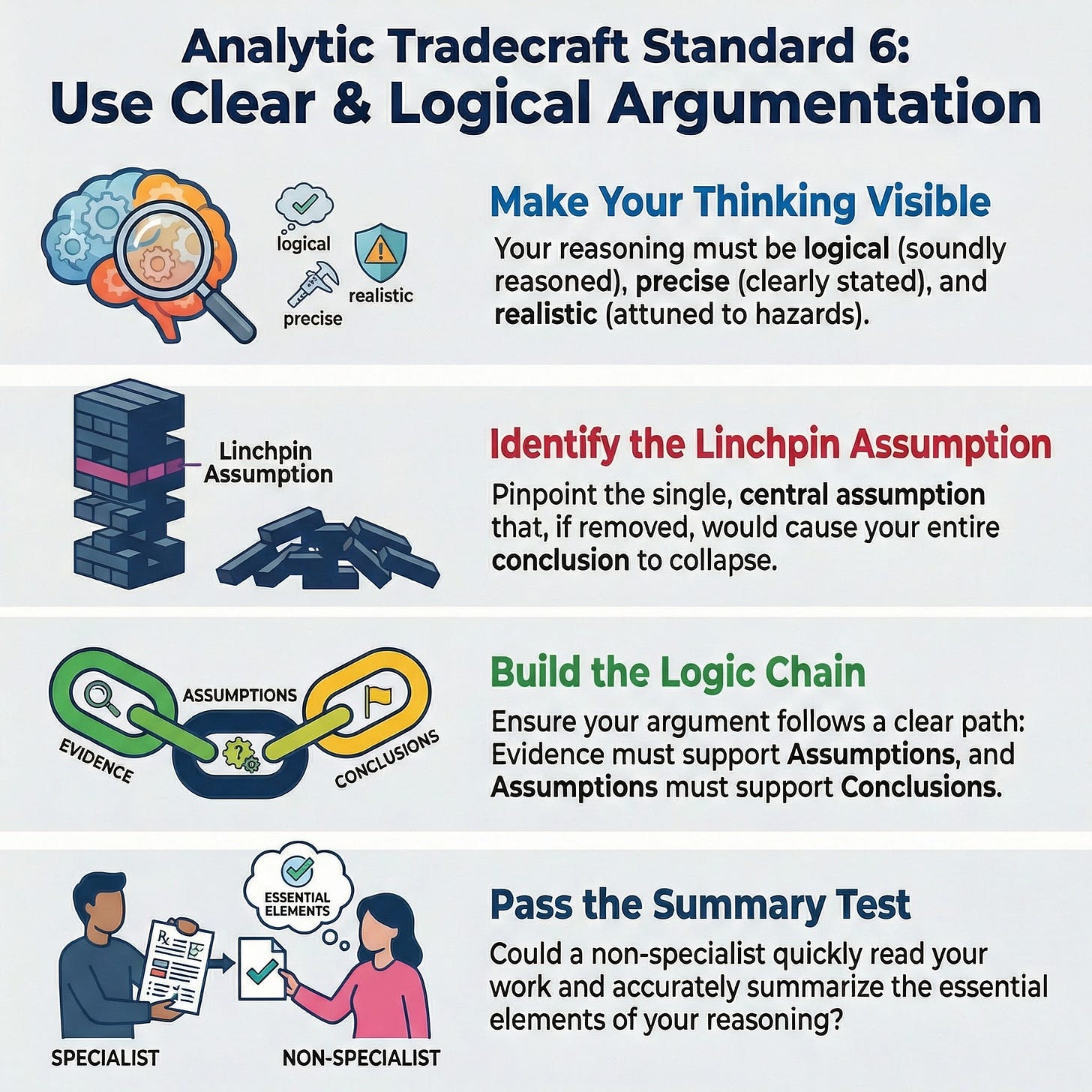
ICD 203 requires that analytic products present a clear main analytic message up front, and products containing multiple judgments should have a main analytic message drawn collectively from those judgments (ICD 203 2015). All analytic judgments should be effectively supported by relevant intelligence information and coherent reasoning, language and syntax should convey meaning unambiguously, and products should be internally consistent and acknowledge significant supporting and contrary information affecting judgments (ICD 203 2015). The CIA defined argumentation as the communication in an intelligence assessment of the structure of the analysts’ critical thinking in support of the bottom-line judgments (CIA 1995). Under CIA tradecraft standards, when policymakers, warfighters, and law enforcement officials are asked to rely on analysis, the reasoning that ties evidence to assumption to judgment must be logical, meaning soundly reasoned; precise, meaning clearly stated; and realistic, meaning attuned to the hazards of forecasting error (CIA 1995).
Those requirements apply to any analyst producing work that someone else will use to make a decision. A private investigator’s report to an attorney, a corporate intelligence assessment for a board of directors, a law enforcement analyst’s threat briefing for a patrol commander: each of these succeeds or fails based on whether the consumer can follow the reasoning from evidence through assumptions to conclusions. A product where the consumer has to guess why the analyst reached a particular judgment, or where the logical connections between evidence and conclusions are implicit rather than stated, has failed the argumentation standard regardless of whether the analyst’s thinking was sound.
What Good Argumentation Requires
MacEachin’s linchpin analysis required analysts to identify the key drivers of a situation and explicitly spell out the assumptions underlying the argument (CIA 1997). A linchpin is the central load-bearing element of an argument; the piece that, if removed, collapses the entire conclusion. If an analyst assesses that a foreign government is likely to comply with a trade agreement, the linchpin might be the assumption that the current political leadership values international reputation over short-term economic gain. Stating that linchpin explicitly does two things: it lets the consumer evaluate whether they find the assumption reasonable, and it gives both the analyst and the consumer a specific indicator to watch. If the political leadership changes or begins signaling indifference to international opinion, the linchpin has shifted and the conclusion needs revisiting.
A due diligence analyst assessing whether a potential acquisition target is financially stable might build the argument on a linchpin assumption that the target’s revenue growth will continue at roughly the same rate over the next two years. Making that assumption explicit forces the analyst to identify the evidence supporting it, the conditions that could invalidate it, and the downstream conclusions that depend on it. If the target operates in a market facing regulatory disruption, stating the linchpin gives the client a clear understanding of what the assessment rests on and where it could break. A law enforcement analyst producing a threat assessment for a major public event might build the argument on the linchpin that a specific extremist group lacks operational capability in the area. Stating that assumption explicitly lets the commander ask follow-up questions: what’s the basis for that assessment? What would change it? What collection would confirm or deny it?
The CIA’s summary test asks whether a consumer who was not reading all the traffic could quickly identify and summarize the essential elements of the assessment’s reasoning (CIA 1995). If the reasoning is buried in background information, spread across disconnected paragraphs, or only implied by the sequence of evidence presented, the product fails this test. The evidence-assumption link test asks whether the depicted hard evidence adequately explains the linchpin assumptions, and whether the assumptions in turn adequately defend the bottom-line conclusions (CIA 1995). Evidence supports assumptions; assumptions support conclusions. If any link in that chain is missing, unstated, or logically insufficient, the argument has a gap the consumer can’t evaluate.
How Reasoning Goes Wrong
Analysts construct arguments under conditions of uncertainty, which means cognitive shortcuts are constantly at work. Heuer described the dominant mode of intelligence analysis as essentially storytelling: the analyst constructs a plot from previous events, and this plot then dictates the possible endings of the incomplete story (Heuer 1999). The story must form a logical and coherent whole, internally consistent and consistent with the available evidence (Heuer 1999). The human drive toward narrative coherence causes analysts to construct explanations that feel complete and logical but rely on hidden assumptions about how events connect.
Analysts generally construct causal explanations that are somehow commensurate with the magnitude of their effects and that attribute events to human purposes or predictable forces rather than to human weakness, confusion, or unintended consequences (Heuer 1999). A corporate intelligence analyst tracking a competitor’s series of acquisitions will tend to construct a narrative of deliberate strategic positioning, even when some acquisitions may have been opportunistic, poorly planned, or driven by internal politics that had nothing to do with competitive strategy. A law enforcement analyst examining a string of robberies will tend to construct a narrative of escalating criminal sophistication, even when some incidents may reflect desperation, poor planning, or copycat behavior rather than a coordinated campaign.
Events are seen as part of an orderly, causal pattern, and randomness, accident, and error tend to be rejected as explanations for observed events (CIA 2009). Coordinated actions, plans, and conspiracies are assumed where coincidence or incompetence may be the better explanation (Heuer 1999). A private investigator tracking financial irregularities in a family business may construct an argument for deliberate fraud when the actual explanation is disorganized bookkeeping and a bookkeeper who’s in over their head. The narrative of deliberate fraud is more coherent, more satisfying as a story, and easier to present to the client, but if it’s wrong, the investigative strategy it generates will be wrong too.
People possess a great facility for invoking contradictory “laws” of behavior to explain, predict, or justify different actions occurring under similar circumstances (Heuer 1999). “Haste makes waste” and “he who hesitates is lost” are both treated as valid principles depending on which one fits the argument being constructed. An analyst can argue that a government’s aggressive posture signals genuine intent to act, and then argue in a different assessment that a different government’s aggressive posture is bluster designed to extract concessions, without recognizing that the same evidence is being interpreted through opposite frameworks. When contradictory reasoning principles are applied across assessments without acknowledgment, the analyst’s argumentation is internally inconsistent even if each individual assessment appears logical on its own terms.
Language as Argumentation
Ambiguous language undermines argumentation because readers fill in ambiguity with their own expectations. When intelligence conclusions are couched in ambiguous terms, a reader’s interpretation of the conclusions will be biased in favor of consistency with what the reader already believes (Heuer 1999). A corporate general counsel reading a vague assessment about regulatory risk will interpret it through the lens of whatever they already think about the regulatory environment. If the analyst intended a specific meaning that differs from the reader’s assumption, the argumentation has failed at the level of communication even if the underlying reasoning was sound.
Burying verbs inside nouns weakens the signal and makes sentences harder to parse. “Chemical attacks are in violation of the treaty” obscures the active claim; “chemical attacks violate the treaty” states it directly (DIA 2015). The difference looks minor in isolation, but across a ten-page assessment, nominalized verbs accumulate into a product that reads as a collection of observations rather than a series of connected analytical claims. Improper parallelism creates a different kind of friction. Readers expect headings and lists to follow parallel grammatical structure, and when they don’t, readers spend cognitive effort parsing structure rather than absorbing content (DIA 2015). An assessment with headings like “Russia’s Military Posture,” “Economic Sanctions and Their Effect,” and “What China Might Do Next” creates a jarring inconsistency that distracts from the substance.
Words already expressing a degree of judgment, such as “imply,” “indicate,” and “suggest,” should not be combined with qualifiers like “may,” “likely,” and “probably” (DIA 2015). DIA calls this signaling language. “The evidence suggests that the group may be planning an attack” stacks two layers of hedging that leave the reader unsure whether the analyst is making a judgment or reporting a possibility. The analyst either assesses the group is planning an attack (with appropriate confidence language) or the evidence is inconclusive and the analyst should say so directly. Stacking signal words obscures the actual analytic message, which is precisely what the argumentation standard requires analysts to present clearly.
Structuring Arguments Through Deliberate Methods
The act of writing forces analysts to think through a problem in ways that internal reasoning alone doesn’t accomplish. Writing reveals flaws in reasoning and identification of the data (Heuer 1999). Heuer described this as externalizing the problem: getting all the pros and cons out of one’s head and onto paper in some visible, shorthand form (Heuer 1999). An analyst who believes they have a clear argument may discover, in the process of writing it down, that two key claims contradict each other, that a critical assumption is unsupported, or that the conclusion doesn’t actually follow from the evidence presented. Peer review reinforces this by introducing perspectives the analyst may not have considered. Heuer recommended that the review process include analysts from other areas who aren’t specialists in the subject matter, because they are better able to identify the assumptions and assess the argumentation, internal consistency, logic, and relationship of the evidence to the conclusion (Heuer 1999). A non-specialist reviewer reading a corporate threat assessment can spot logical gaps that a subject-matter expert might skip over because their background knowledge fills in what the text leaves out.
Argument mapping breaks an analytic product into its component claims, evidence, and assumptions, then diagrams the logical relationships between them. When an analyst maps an argument visually, unsupported claims and logical gaps become visible in ways that linear prose can obscure. A law enforcement analyst preparing a gang threat assessment could map the argument by identifying each major claim (the gang is expanding into new territory, recruitment is accelerating, leadership has consolidated), the evidence supporting each claim, and the assumptions connecting them. If the claim about territorial expansion rests entirely on the assumption that increased arrests in the new area reflect gang activity rather than a change in policing strategy, mapping makes that dependency visible.
The structured techniques covered in the article on analysis of alternatives, including ACH, key assumptions check, and Team A/Team B, serve an argumentation function as well. ACH ensures that all the information and argumentation is evaluated and given equal treatment when considering each hypothesis (CIA 2009), and Heuer argued that any written argument for a certain judgment is incomplete unless it also discusses alternative judgments that were considered and why they were rejected (Heuer 1999). Team A/Team B requires each side to structure their argument with an explicit presentation of key assumptions, key pieces of evidence, and careful articulation of the logic behind the argument (CIA 2009). These techniques were designed to improve analytic thinking, but their byproduct is better argumentation because they force the reasoning into a structure the consumer can follow.
DIA’s PACE Essentials course requires analysts to be able to construct a solid argument for an analytic conclusion that answers a defense intelligence question upon completion (Department of Defense Inspector General 2023). Treating argumentation as a trainable skill acknowledges that clear reasoning in a finished product requires deliberate practice. Analysts across disciplines, whether in government, law enforcement, corporate intelligence, or private investigation, benefit from the same discipline: identify your main claim, state your evidence, make your assumptions explicit, acknowledge contrary information, and ensure the logic connecting these elements holds up to scrutiny from someone who doesn’t already agree with you.
Closing
MacEachin’s weekend reading exercise revealed something that hasn’t changed in the decades since: analysts who think clearly don’t automatically write clearly. The reasoning that leads to a judgment and the reasoning that appears in the finished product are two different things, and the gap between them is where argumentation fails. An analyst may have worked through every alternative, tested every assumption, and weighed every piece of evidence carefully, but if the product doesn’t show that chain of reasoning in a form the consumer can follow and challenge, the work is invisible. The consumer sees a conclusion and has to take it on faith.
Closing that gap requires treating the written product as an argument rather than a briefing. State the main claim. Show what evidence supports it. Name the assumptions that connect the evidence to the conclusion, especially the linchpins that would collapse the argument if they proved wrong. Acknowledge the information that cuts against your judgment and explain why you weighed it the way you did. If you’ve considered and rejected alternative explanations, say which ones and why. Every one of those steps is something the consumer can evaluate, push back on, or use to calibrate how much weight to place on your conclusion.
The standard isn’t perfection; it’s transparency. No analyst gets every judgment right, and no argument is airtight when the subject involves human behavior under uncertainty. What the consumer deserves is the ability to see how you got where you got, to decide for themselves whether your reasoning holds, and to know exactly where the argument would break if conditions change. That’s what separates analysis from assertion.
References
Central Intelligence Agency. 1995. A Compendium of Analytic Tradecraft Notes. Directorate of Intelligence.
Central Intelligence Agency. 1997. Analytic Tradecraft Standards. Directorate of Intelligence.
Central Intelligence Agency. 2009. A Tradecraft Primer: Structured Analytic Techniques for Improving Intelligence Analysis.
Defense Intelligence Agency. 2015. Style Manual for Intelligence Production.
Department of Defense Inspector General. 2023. Evaluation of Analytic Standards Implementation.
Heuer, Richards J. 1999. Psychology of Intelligence Analysis. Central Intelligence Agency.
ICD 203. 2015. Analytic Standards. Office of the Director of National Intelligence.
This piece was first published on our Substack.
Read the original on Substack