Valentine’s Day is one of the biggest days of the year for online dating activity, and scammers know it. FBI field offices across the country issued warnings this week, and the data backs them up: romance scams spike every February as more people turn to dating apps and social media looking for connection. Check Point researchers found that new Valentine-related domains jumped 44% in January 2026 compared to monthly averages, with another 152 appearing in just the first five days of February. If you’re swiping this weekend, or you know someone who is, this is worth reading.
My goal is to walk you through how romance scams work, who they target (the answer will surprise you), and what you can do to protect yourself and the people you care about. This is also a look at a problem much bigger than most people realize: a global criminal enterprise that generates tens of billions of dollars a year and traps hundreds of thousands of trafficking victims in forced labor compounds across Southeast Asia. The scammer may also be a victim.The numbers are enormous, and they’re probably only 10% of the real picture
Americans reported losing at least $672 million to romance and confidence scams in 2024 through the FBI’s Internet Crime Complaint Center (IC3) alone. The FTC recorded over $800 million. An AARP survey released this month found that nearly 1 in 10 Americans over 50, roughly 11 million people, had made an online romantic connection and been asked for money or steered toward cryptocurrency investments, and 55% of incidents were never reported.
Those numbers are almost certainly low. Many romance scams evolve into cryptocurrency investment fraud, what’s called “pig butchering,” and get reclassified as investment fraud in the statistics. The FBI reported $6.5 billion in investment fraud losses in 2024 and $9.3 billion in cryptocurrency-related fraud, and a substantial portion started as romance scams. Chainalysis found that pig butchering deposits alone surged 210% year-over-year in 2024, with scammers stealing over $4 billion through that single method.
The median individual loss reported to the FTC is $2,000, but averages paint a harder picture: FBI data from North Carolina showed $36,000 per victim in 2024, and victims over 60 reported $389 million to the FBI that year, with individual losses frequently reaching six figures. The FBI San Francisco Division reported $40 million lost in Northern California in 2025, nearly double the prior year. FBI Boston reported 700+ victims and $20 million in New England. Texans lost $57 million in 2024. Those are three field offices out of 56. Internationally, the UK recorded £106 million in losses in fiscal year 2024-25, an 18% increase, and INTERPOL’s Operation HAECHI across 40+ countries resulted in 5,500 arrests and roughly $400 million seized.
Anyone Can Be Targeted
Monica Whitty’s 2018 peer-reviewed study found that more highly educated people were actually more vulnerable to romance scam victimization. FBI Supervisory Senior Agent Michael Rod has said the Bureau routinely encounters lawyers, doctors, judges, and pilots among victims. Education, income, and professional status don’t protect you; smart people are better at rationalizing red flags, which makes them easier to keep on the hook.
When someone is in the early stages of romantic connection, dopamine creates reward-seeking behavior, oxytocin builds powerful trust bonds, and serotonin drops in ways that mimic obsessive-compulsive patterns. fMRI research shows that intense romantic feelings decrease connectivity in the orbitofrontal cortex, the brain region responsible for critical judgment, while emotional networks become hyperactive. As trauma expert Dr. Melissa Kalt explains, scammers are “hacking biology”: the part of your brain that would normally flag a threat shuts down.
The primary predictor of who gets targeted is emotional vulnerability during life transitions: recently lost a spouse, gone through a divorce, moved to a new city, going through a lonely stretch. That’s not a weakness, it’s just being human. An AARP survey found that while 62% of adults view romance scam victims as targets of crime, 60% also assume victims were “naïve or too trusting,” and that assumption is wrong and one of the biggest reasons victims don’t report.
The demographics defy every stereotype. Javelin Strategy research found 73% of romance scam victims in one survey were men. UK data shows male victims now slightly outnumber females, though women tend to lose larger sums. Adults 50+ are frequent targets, particularly those who are widowed, divorced, or recently bereaved, and people aged 18-29 are the most common victims of sextortion, where scammers use intimate images to extort money.
How The Scams Work
Scammers cast wide nets across dating apps (Tinder, Bumble, Hinge, Match, Plenty of Fish), social media (Facebook, Instagram, LinkedIn), and increasingly through cold outreach like “wrong number” text messages, which have become a signature pig butchering opener. The FTC found that 40% of romance scam victims said contact started on social media, not dating sites, while only 19% began on a dating app. February is peak season because more people are active on these platforms around Valentine’s Day, and scammers ramp up to match.
The fake personas are built around jobs that explain why they can’t meet you: military personnel deployed overseas, offshore oil rig workers, doctors in war zones, international construction contractors. Photos are stolen from real people or generated by AI tools that produce photorealistic images you can’t find through reverse image search. Backstories typically include a dead or absent spouse, a child in boarding school, and an immigrant background that explains any accent.
Once contact is established, scammers shower victims with constant attention: daily check-ins, deeply personal conversations, rapid expressions of love, and future planning. Classic phrases include “I’ve never felt this way before” and “You’re different from everyone else.” Research analyzing over 134,000 text messages between scammers and victims found that scammers embed justifications for later financial requests from the very first interactions. They mirror victims’ values, interests, and communication styles with striking precision, sometimes using commercially available guides. Small gifts may arrive, food delivery, personalized mugs, photo pillows, all building trust before money is ever requested.
Communication moves to encrypted platforms like WhatsApp or Telegram, away from dating apps with fraud detection, and scammers actively discourage contact with friends and family: “They won’t understand our connection” or “Let’s keep this between us for now.” Every person who might say “this doesn’t add up” gets cut out of the picture, and by the time money enters the conversation, the victim’s only trusted confidant is the scammer.
In traditional romance scams, the ask starts with fabricated emergencies, medical crises, legal trouble, being stranded overseas, customs fees on shipped gifts, beginning small and escalating. In pig butchering schemes, the scammer casually introduces investment success, guides the victim to open accounts on legitimate cryptocurrency exchanges, then directs transfers to fraudulent platforms displaying fabricated returns where small withdrawals are permitted initially to build confidence. When the victim commits significant funds, the platform disappears.
Scammers rarely quit after one payment. Some continue the relationship indefinitely, extracting progressively larger sums. Others turn victims into unwitting money mules, having them receive and forward stolen funds through their own bank accounts, which is a federal crime. The FBI estimates money mules help launder an additional $6 billion beyond direct romance scam losses. After the primary scam ends, victims are often targeted again by “recovery scammers” posing as law enforcement or asset recovery specialists who promise to retrieve stolen funds for an upfront fee. The FTC is clear on this: “Never pay upfront for a refund or help with a refund. Anyone who asks for your personal or financial information or for upfront fees is a scammer.”
Pig Butchering
The pig butchering scam (杀猪盘, shā zhū pán) is the fastest-growing form of romance fraud, and the losses dwarf traditional romance scams. The name comes from the Chinese agricultural metaphor: scammers “fatten” victims with affection and small apparent investment gains before the “slaughter,” extracting every available dollar.
After weeks or months of relationship building, the scammer mentions impressive cryptocurrency returns and offers to “teach” the victim to invest. Victims set up accounts on legitimate exchanges like Coinbase, then transfer funds to fraudulent trading platforms that display fabricated gains. These platforms are sophisticated enough that some have been available on Apple’s App Store and Google Play. When victims try to withdraw significant amounts, they encounter demands for “taxes,” “service fees,” or claims their accounts are frozen, and eventually the platform vanishes entirely.
The FBI’s Operation Level Up, which proactively identifies victims early in these schemes, notified 8,103 victims in 2024, 77% of whom had no idea they were being scammed, and estimated it saved victims $511.5 million. Eighty of those victims required referral for suicide intervention, and some were in the process of liquidating 401(k)s, selling homes, or obtaining massive loans when the FBI reached them.
CEO Shan Hanes, a respected community banker in Elkhart, Kansas, fell victim to a pig butchering scheme and embezzled $47 million from his own bank to feed the scam, directly causing the institution’s failure; he was sentenced to 24 years in prison. Jackie Crenshaw, a 59-year-old woman, lost approximately $1 million, her entire retirement, after a scammer on the BLK dating app timed his extraction to coincide with the moment she could withdraw from her 403(b) without penalty; her condo is now in foreclosure after 26 years of mortgage payments.
AI Makes Scamming Easier
AI-generated photos create photorealistic images of people who don’t exist and can’t be found through reverse image search, which used to be one of the most reliable ways to catch a fake profile. A French woman lost $850,000 to a scammer using AI-generated images of Brad Pitt; she had searched for the images online and found nothing because they were originals.
Real-time deepfake video calls have undermined the “just video chat them” advice that was once considered proof someone was real. Platforms offering face-swapping during live calls now include 50+ adjustable facial parameters, integration with WhatsApp and Zoom, and natural blinking, smiling, and talking. Hong Kong police arrested a fraud ring in October 2024 that used deepfakes to defraud victims across five countries of $46 million, and deepfake fraud in the U.S. surged 700% in early 2025.
A single operator can now run 50+ victims at once using AI chatbots that track relationship history, personal details, and emotional triggers while adapting writing style to match each victim. AI service vendors within scam ecosystems grew 1,900% between 2021 and 2024, and the traditional red flags, poor grammar, stilted language, repetitive phrasing, have largely vanished. Open-source intelligence (OSINT) tools scrape social media and leaked datasets to build target profiles before first contact: income range, recent divorce, travel interests, communication style. When a scammer seems to share all your interests and values, that alignment was likely researched in advance.
Scammers May Be Victims
This was a super hot take and very controversial when I mentioned it last year, but it’s true. INTERPOL estimates that more than 300,000 people are currently held in scam compounds across Southeast Asia, and the U.S. Institute of Peace places the figure at 350,000 in Cambodia, Myanmar, and Laos alone. The UN documented workers trafficked from at least 56 countries. Many of the people running these scams are doing it at gunpoint.
Erin West and Operation Shamrock are worth following on LinkedIn as they are doing incredible work in this area- you’ll learn a lot more from them. You can also check out their website here: https://www.operationshamrock.org/.
These compounds are concentrated in Myanmar’s Myawaddy border region, Cambodia’s Sihanoukville, Laos’s Golden Triangle Special Economic Zone, and the Philippines: repurposed hotels, casinos, and office complexes surrounded by concrete walls, barbed wire, surveillance cameras, and armed guards. The industry originated from Chinese-run online gambling operations that pivoted to fraud after Cambodia’s 2019 gambling ban and COVID-19 restrictions, and conservative estimates place annual revenue at $50-75 billion for the region. Workers are recruited through fake job advertisements promising well-paying positions in IT, customer service, or e-commerce. Upon arrival, passports are confiscated, workers are told they owe fabricated debts for travel and accommodation, and resistance is met with violence. Amnesty International’s 2025 investigation interviewed 58 survivors and found that 40 had suffered torture or other ill-treatment, including beatings with PVC pipes and clubs, electric shock, confinement in designated “dark rooms,” and threats of forced prostitution and organ harvesting. Workers are forced to operate 12-20 hours daily, six days a week, with quotas requiring their team to generate $10,000 or more per day.
The death of Park Min-ho, a 22-year-old South Korean student lured to a compound by a friend, brought global attention to the crisis; he died of cardiac arrest in August 2025 after being beaten so severely he could not walk or breathe. Chinese actor Wang Xing’s rescue from the notorious KK Park compound in January 2025 triggered a coordinated China-Thailand-Myanmar crackdown that freed over 7,000 people. The October 2025 DOJ indictment of Chen Zhi, chairman of Cambodia’s Prince Group, described operations involving “phone farms with thousands of phones and millions of mobile numbers” and resulted in the largest bitcoin forfeiture in DOJ history, approximately $15 billion.
As a former U.S. Ambassador to Combat Trafficking stated: “We have literally never seen a world crisis like this. We’ve got Americans and people all over the world who’ve lost all their money. And then on the other side, we have human trafficked victims that are forced to do this dirty work.” When someone responds to a pig butchering text, the reply often comes from a worker halfway around the world, forced to work 16-hour days, sending message after message until someone responds. Survivors who escape face an additional cruelty: Thai police estimates indicate nearly 70% of identified cyber-slavery survivors face legal exposure for the crimes they were forced to commit.
What Law Enforcement Is Doing
Most scammers operate from West Africa or Southeast Asia, beyond the practical reach of U.S. law enforcement, and investigations require tracing funds through domestic money mules, multiple bank accounts, cryptocurrency mixers, and international wire transfers. Academic research analyzing 344 DOJ cases found that approximately 80% of romance scam perpetrators operated from overseas.
Law enforcement has scored significant wins despite those constraints. INTERPOL’s Operation First Light 2024 spanned 61 countries, resulting in 3,950 arrests and seizure of $257 million, and Operation HAECHI recovered $342 million in currency and $97 million in digital assets. The DOJ has prosecuted numerous domestic defendants: a Houston couple received sentences of 188 and 121 months for a $3.1 million scheme targeting elderly widows; a Bronx woman received 63 months for laundering $2 million through 18 bank accounts; a Los Angeles man received 20 years for a $73.6 million conspiracy. The FBI’s Scam Center Strike Force, established in 2025, represents a dedicated institutional commitment.
Asset recovery is almost impossible for most victims. The three largest U.S. banks reimbursed only 2%, 4%, and 24% of affected customers for authorized wire transfers in 2023. Cryptocurrency recovery is extremely difficult, though the FBI seized $8.2 million in USDT (a cryptocurrency pegged to the US dollar) in one Ohio case, and UK firm Grant Thornton recovered $900,000 through blockchain tracing. Credit card chargebacks offer the best odds, with federal law limiting liability to $50. OSINT practitioners and private investigators are playing a growing role using reverse image search, metadata analysis, and blockchain analytics to trace funds, but they lack legal authority to compel action, and for most victims the probability of recovering losses is very low. Catching a scam early matters far more than trying to recover from one.
Red Flags
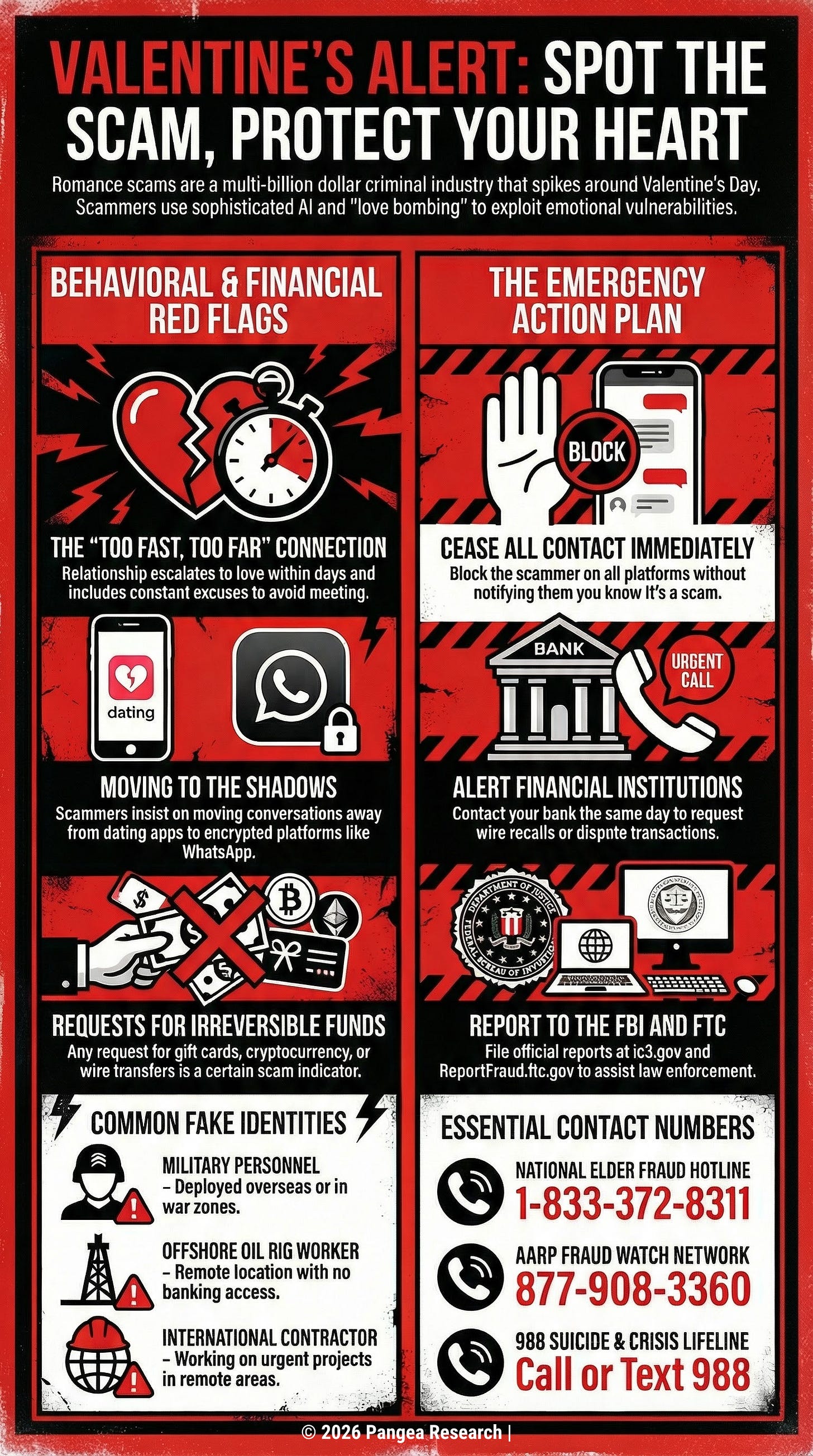
Certain behavioral patterns show up consistently across documented cases. The person avoids or repeatedly delays video calls and in-person meetings, usually with explanations that sound reasonable on the surface. The relationship escalates quickly, with strong emotional declarations within days or weeks. Communication is pushed onto encrypted platforms such as WhatsApp or Telegram, and the target is subtly or directly steered away from discussing the relationship with friends or family. Plans to meet are scheduled and then cancelled because of sudden emergencies. Marriage may be proposed despite never having met in person. Over time, small inconsistencies begin to surface in personal details, work history, location, or timelines. These behaviors form a recognizable pattern rather than isolated red flags when they’re all happening together.
Any request for money from someone you’ve never met in person should be treated as a scam indicator, full stop. Gift cards (24% of cases), cryptocurrency, wire transfers, and payment apps are all preferred because they’re fast, hard to trace, and essentially irreversible. Requests to invest in recommended cryptocurrency platforms are a hallmark of pig butchering, and requests to open bank accounts or receive and forward money could make you an accessory to federal crimes.
Scammers rely on a set of cover stories that show up again and again in reported cases. They claim overseas military deployment, work on an oil rig, or assignments on medical and construction projects in remote locations because those roles explain distance and limited access. The FTC reports that victims cited military deployment and “an important delivery” in 18 percent of romance scam reports each. Scammers use these narratives to justify why they cannot meet, cannot reliably video chat, or suddenly need money tied to travel, equipment, or fees.
They also construct personalities that feel unusually aligned with the target. They study social media profiles, mirror interests and values, and say exactly what the other person wants to hear. That alignment rarely happens by chance. It reflects research and a scripted engagement process designed to accelerate emotional attachment.
You can often see the impact in behavioral changes. The person involved may hide online activity, move money in unusual ways such as withdrawing savings, taking loans, or buying gift cards in bulk, and react with sharp emotional swings. They may pull back from friends and family, become defensive when questioned, or repeatedly reference a partner they have never met in person who always has a reason they cannot visit. When these patterns cluster together, they point to sustained manipulation rather than an ordinary long-distance relationship.
What to do if you’re being scammed, or think someone you know is
Stop all contact. Block the scammer’s phone number, email, and social media profiles without notifying them you know it’s a scam.
Stop sending money immediately, regardless of claimed emergencies.
Preserve all evidence. Save every message, screenshot conversations, keep receipts and bank statements.
Contact your financial institutions the same day. Request wire recalls, file chargebacks, dispute transactions, and freeze accounts. Speed matters; scammers empty receiving accounts almost immediately.
File reports with every relevant authority:
FBI’s IC3: ic3.gov
FTC: ReportFraud.ftc.gov
U.S. Secret Service
Local law enforcement (bring your IC3 and FTC report numbers)
The dating or social media platform where contact occurred
If you are 60 or older, call the National Elder Fraud Hotline at 1-833-FRAUD-11 (1-833-372-8311), which assigns personal case managers.
If personal information was shared, place credit freezes with all three bureaus, enable two-factor authentication on all accounts, and report to IdentityTheft.gov.
Helping someone you suspect is being scammed is one of the hardest things you can do. Direct confrontation almost always backfires, pushing the person closer to the scammer, because the scammer has spent weeks or months building emotional dependency and cutting them off from outside perspectives. A challenge from a friend or family member feels like an attack on the relationship. Experts recommend expressing concern rather than accusation (”I’m worried about you”), asking open-ended questions, and sharing resources casually rather than demanding action. One effective technique is a written agreement to perform a simple test: run a reverse image search on the scammer’s photos, then ask the scammer to send a specific photo (touching a finger to their nose, holding a paper with today’s date) that would be impossible to produce from stolen images. If both tests fail, the prior agreement helps the person accept what’s happening. This may take weeks. Stay present and stay patient.
Resources, Reporting, and Recovery
Reporting
FBI’s Internet Crime Complaint Center: ic3.gov
FTC: ReportFraud.ftc.gov
Identity theft: IdentityTheft.gov
Recovery and Support
AARP Fraud Watch Network (877-908-3360): trained fraud specialists, emotional support, and free virtual support groups including romance scam-specific sessions; their VOA|ReST program provides structured peer-facilitated recovery
SCARS (Society of Citizens Against Relationship Scams): a 120-day recovery program, free support groups, counseling referrals, and a comprehensive scam education platform
Cybercrime Support Network: a free 10-week Romance Scam Recovery Group led by a licensed counselor with trauma-informed facilitators
National Elder Fraud Hotline (1-833-372-8311): operated by the DOJ, assigns personal case managers who assist with reporting and resource connection
988 Suicide & Crisis Lifeline: call or text 988 for immediate support
Therapists specializing in trauma recommend EMDR (Eye Movement Desensitization and Reprocessing) and trauma-focused cognitive behavioral therapy for romance scam recovery. SCARS recommends trauma therapy for all scam victims, noting that many develop PTSD-like symptoms. Recovery closely parallels grief processing: people need to mourn a relationship that felt profoundly real, and they deserve support while doing it.
A final word for Valentine’s Day
There’s nothing foolish about wanting connection. The people who get caught up in romance scams are targeted by operations that exploit basic neuroscience at scale, and the reported statistics almost certainly represent a fraction of the real damage. Behind the numbers are people on both sides of the screen: those who lost their savings and those enslaved in compounds and forced to steal them.
If you’re on a dating app this weekend, enjoy it, but keep an eye out for the patterns described here and trust your gut if something feels off. If someone you’ve never met in person asks you for money, cryptocurrency, or investment participation, regardless of how real the connection feels, regardless of the emergency: stop and talk to someone you trust first. If you know someone who might benefit from reading this, send it to them, because that conversation might be one of the most useful things you do this Valentine’s Day.
This piece was first published on our Substack.
Read the original on Substack